Earlier this year, I received an email inquiring about my story on Simandoa conserfariam, the extinct in the wild roach. The sender was Maddy Ruth, a multimedia artist working on a comic book. We exchanged a few emails about my sources and whether or not the cave S. conserfariam was found in still existed, and then that was that.
Recently, I stumbled back upon Maddy’s comic, now available from Microcosm Publishing as Bugs in Peril, which retells across 32 pages S. conserfariam‘s discovery, description, and subsequent wild extinction in a captivating hand-drawn style.
I was immediately intrigued at how Maddy told the story of this roach visually, and had to learn more about the process that went into making the plight of S. conserfariam into a comic book, as it’s not every day you see an obscure insect headline a comic! I was also curious to learn more about their approach to art in general and their inspiration for this story. Responses and questions have been lightly edited for clarity.
Arthroverts: Your website says you are a “science inspired illustrator.” What’s been your artistic journey to this point?
Maddy Ruth: I’ve been an artist my whole life. When I was younger and mainly drew cool dragons and some animals, it was a way for me to connect to my peers. I wasn’t a very socially skilled child, so being an artist really helped a lot as a way to make friends. I honestly owe almost all of my close friendships to the fact that we bonded over art first. But once I started art school, I knew I had to start taking my art more seriously, and due to some conflict and possible regret about not going to school for some form of environmental science led me to wanting to figure out how to use my art to further conservation and help people find connections to the wild, strange world around them. Even if I’ve been an artist for all my life, I still feel very early in my journey. I’m not exactly sure where I’m going to end up just yet!
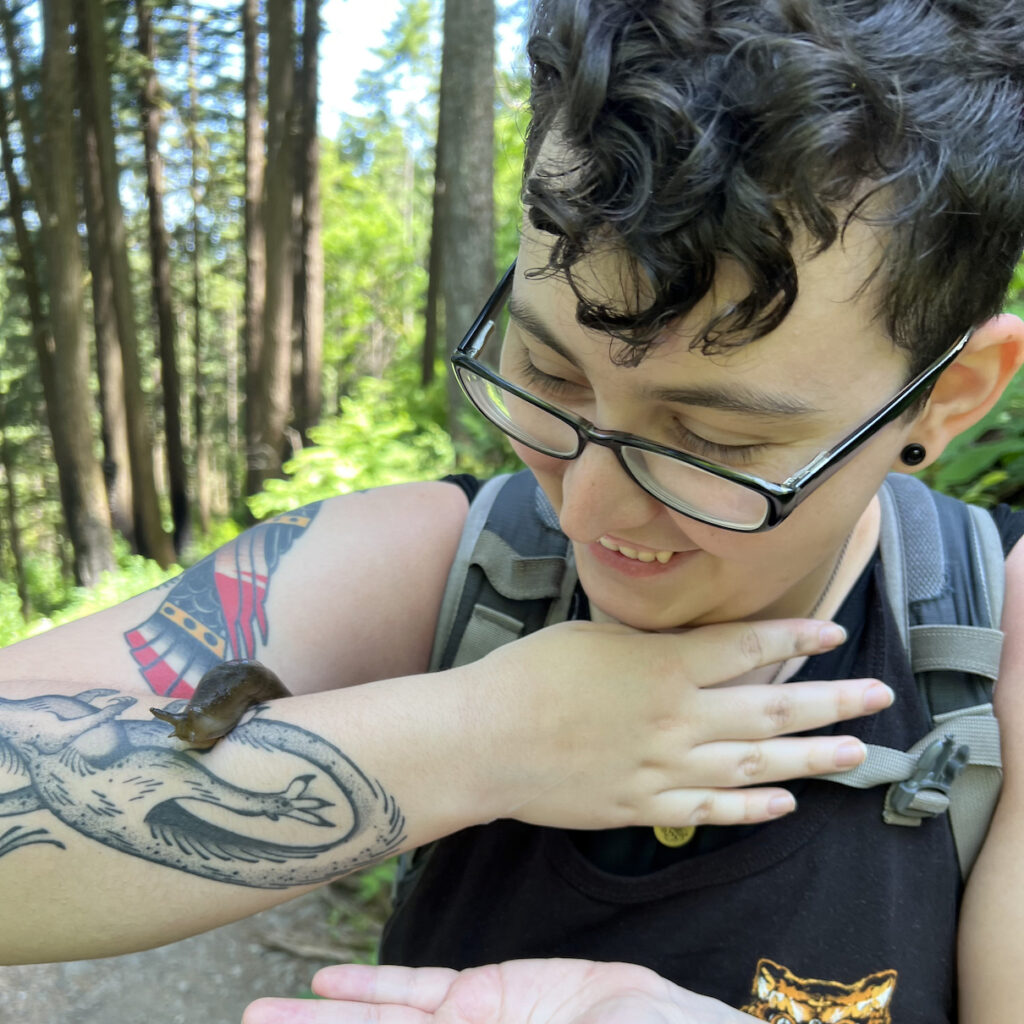
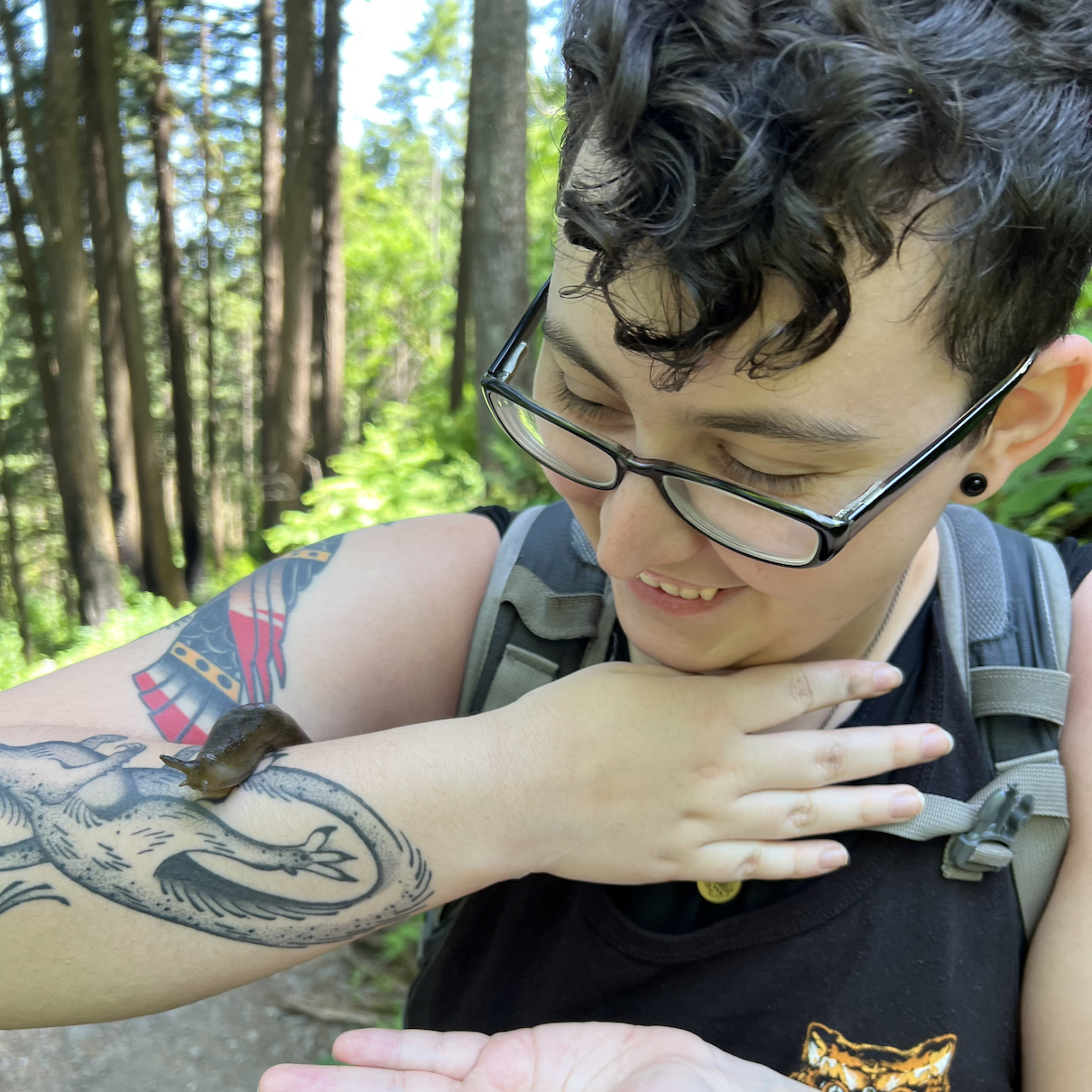
Maddy Ruth with a slug.
AR: You do a lot of work on invertebrates and other creatures that aren’t as charismatic as, well, charismatic megafauna, ha ha. Why are you drawn to drawing these animals?
MR: As a science nerd, I love weird beasts. And as an artist, strange beasts often have very fun shapes and patterns to draw! Along with those facts, I draw what I’m passionate about. Often, the offputting creatures I enjoy reading about are critically endangered or simply understudied, usually because they don’t receive the funding or attention to be deemed worth protecting or studying. I draw these creatures not only because I find them fun to draw, but because art is such a great way to introduce others to the beauty and wonder I see in all the weird animals I’m fond of.
Also I used to be really mad about how only megafauna got all the conservation attention, but nowadays I’ve grown enough to recognize that you can’t protect a tiger without protecting the environment it lives in, which happens to often include all my little weird creatures at the bottom of the food chain. So I’ve made peace with the big charismatic megafauna, and I have to admit some of them are very fun to draw, haha.
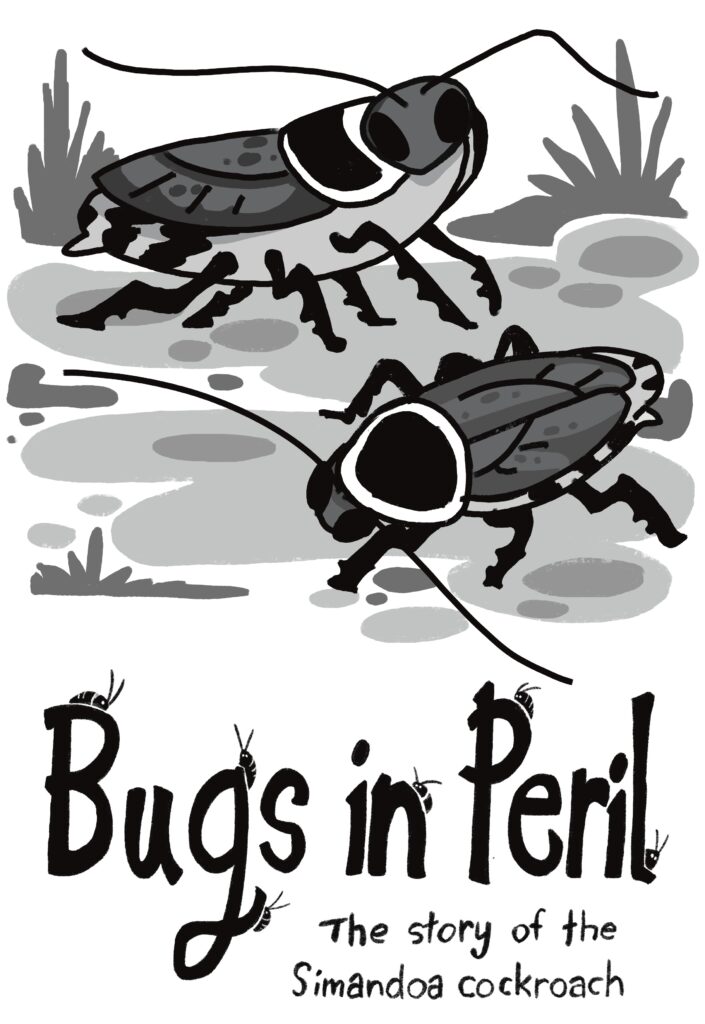
The cover of Bugs in Peril. Maddy Ruth.
AR: That said, you’ve also done a lot of work with dinosaurs, probably the definition of charismatic megafauna, but you still focus on the species that people probably aren’t familiar with (as in the name of your first comic, Greatest Prehistoric Animals You Know Nothing About!). What do you want to achieve through telling the stories of these forgotten creatures?
MR: I think people have a very narrow perception of the past inhabitants and lands of earth. Ecosystems of the past were explosively vibrant with life. Bees buzzed, mosquitoes swarmed, tiny weird vegetarian crocodiles ran around! But most people, when they recall past time periods, can only name the biggest and baddest. I want people to understand that massive dinosaurs lived alongside thousands of other species, like the giant dragonflies Meganeura! I think dinosaurs and strange prehistoric creatures can also be a great gateway into introducing those more drawn towards fantastical elements to look closer at the world around them, because honestly, a lot of strange creatures used to exist, and sometimes, those things feel more like they came from a fantasy novel than the past. I mean, have you seen Synthetoceras? That is a fantasy deer, and I love it dearly.
There is something beautiful and interesting everywhere, you just have to look. I want to expand people’s views of nature by introducing them to all their neighbors, big and small.
AR: Tell me about the process of writing Bugs In Peril. Why was this a story you wanted to tell?
MR: I first discovered Simandoa conserfariam in high school on some sort of web forum. I was drawn to the story quickly because I was a teenager who felt alone and lost, and I grabbed onto this tale as an example of how much good a single action can do. It became fiercely important to me. I did try to tell the story when I was younger as a comic for one of my classes. At the time I wrote the story based only on the legend of Simandoa without doing any further research, which led to some…interesting choices! But I was so proud of it and I learned a lot while doing it. In the back of my mind I always knew that when I was a better artist, I wanted to do another, better version. Well, in 2024, I finally decided to take the leap.
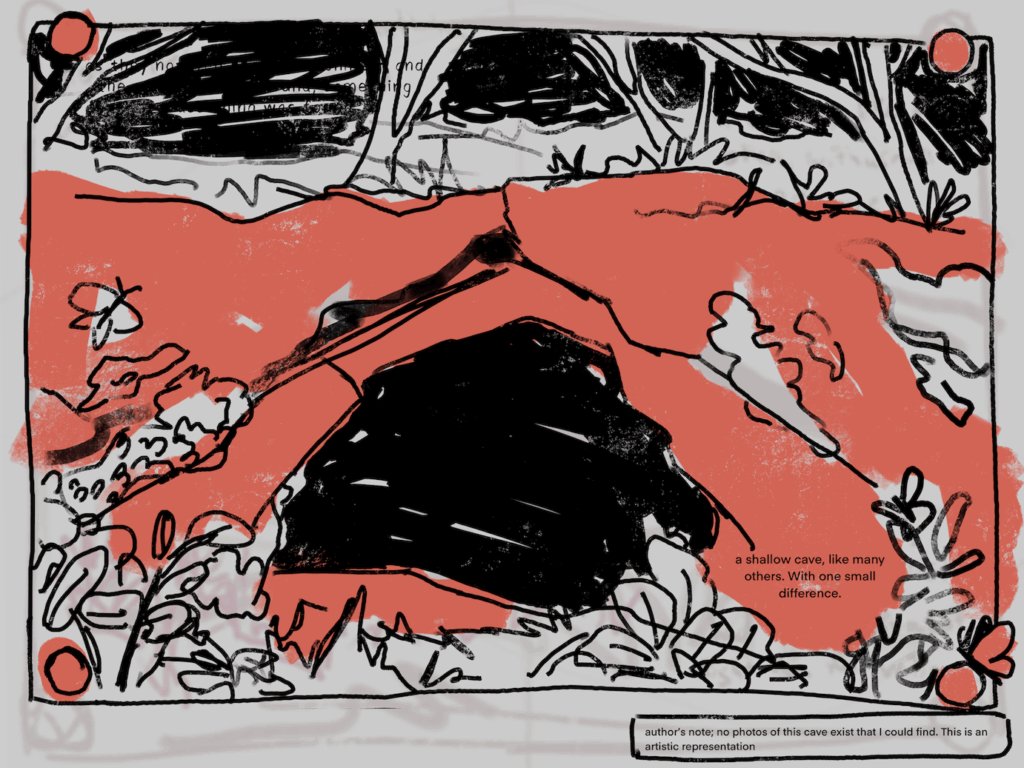
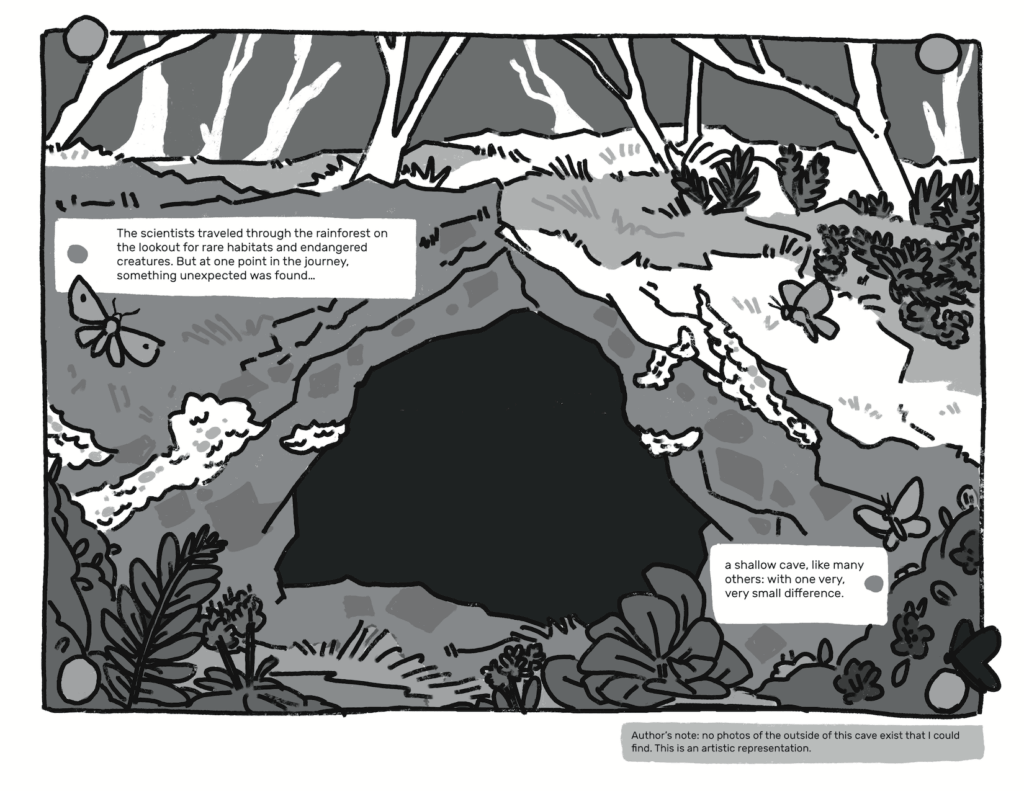
Side-by-side of development art and finished page in Bugs in Peril illustrating what the cave S. conserfariam was found in might have looked like. Maddy Ruth.
AR: What do you hope people take away from Bugs In Peril, and your art in general?
MR: Every little creature is alive, and you are part of nature. There is something beautiful and interesting everywhere, you just have to look. I want to expand people’s views of nature by introducing them to all their neighbors, big and small. Creatures I hope they will then wish to protect.
AR: What was the process of finding a publisher for Bugs in Peril like?
MR: Originally, Bugs in Peril was going to be self-published, so it was honestly entirely a shot in the dark! I received another zine as a gift, saw Microcosm was the publisher, and what did you know, they were accepting queries! Bugs in Peril was about 3/4ths of the way done at this point, so I submitted it. And Microcosm was ecstatic about the idea!
AR: Your art in many ways, especially in Bugs in Peril, seems to have a lot of visual influence from risograph printing. Is that accurate? What are your primary artistic influences?
MR: This question made me laugh! See, when Bugs in Peril was still going to be self-published, it was going to be risograph printed, in black and orange. I love the look of risograph, and am so excited by it as a medium. Bugs in Peril may eventually receive a limited risograph printing run in the future still!
Artistic influences are something I could talk about for a long long time. But thinking about it, I think I have a hard time trying to pin down any primary influences. That may be related to my status as a multimedia artist, or just my personality. I would have to say my biggest influence is my wonder, and the wish to share all the strange and wonderful things I learn about the life around us.
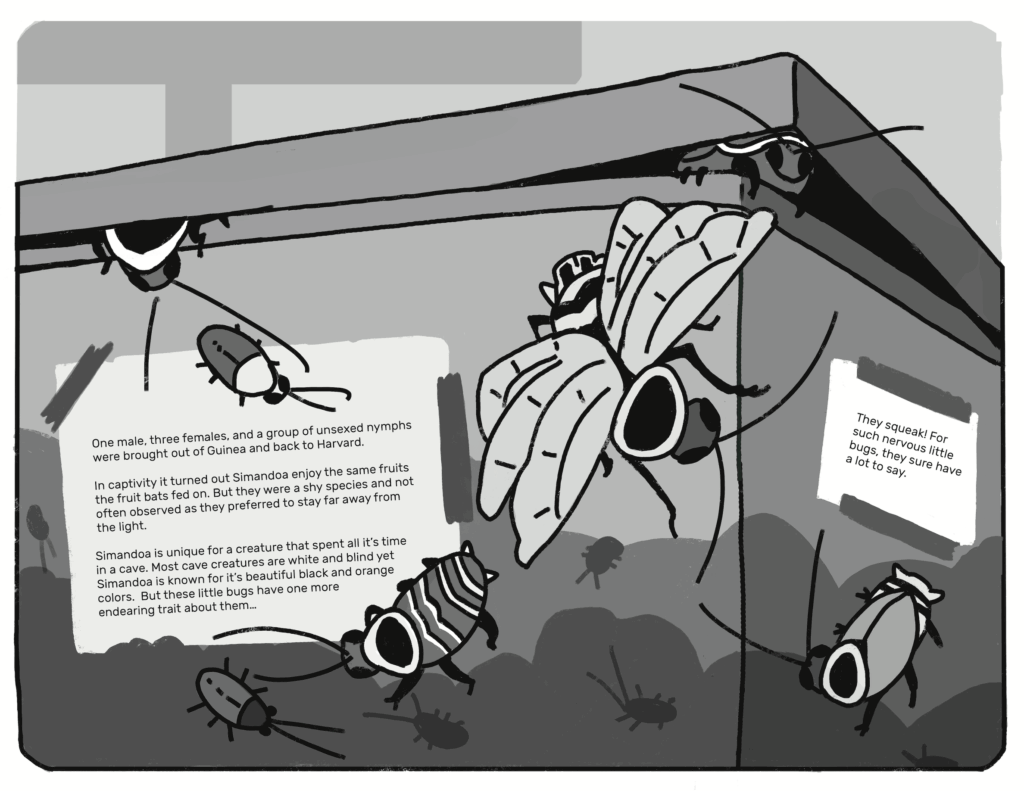
A finished page in Bugs in Peril. Maddy Ruth.
AR: What advice would you give to someone else wanting to make comics on these kinds of niche stories?
MR: Do it. If the story is important to you, it’s important to tell! And there’s nothing better than learning highly specific things about something someone is very passionate about. I doubly encourage you if it is anything related to STEM; comics are a great way to introduce people to new topics and ideas. I truly believe they could have an even larger space in the sci-com world in the future! Come join me on this journey.
AR: Any sneak peeks on your next project?
MR: Well! I am a chaotic beast who has to have multiple projects in the works at once. I’m currently making new art, designing stickers, and slowly planning future large-scale projects. One involves the Devils Hole Pupfish.
My very long term project I am nibbling away at is a science fiction novel, where I’ve taken all my love for the true weird and strange biology of our earth, as well as inspirations from stories like Annihilation, Pacific Rim, and the brainmelting book Entangled Life by Merlin Sheldrake. Without spoiling anything, it looks at what living with non-humanoid intelligent life might look like, and a mystery about the consequences of those interactions. The first draft will be done early 2026, and I hope to see it published eventually.
Comics are a great way to introduce people to new topics and ideas; I truly believe they could have an even larger space in the sci-com world in the future!
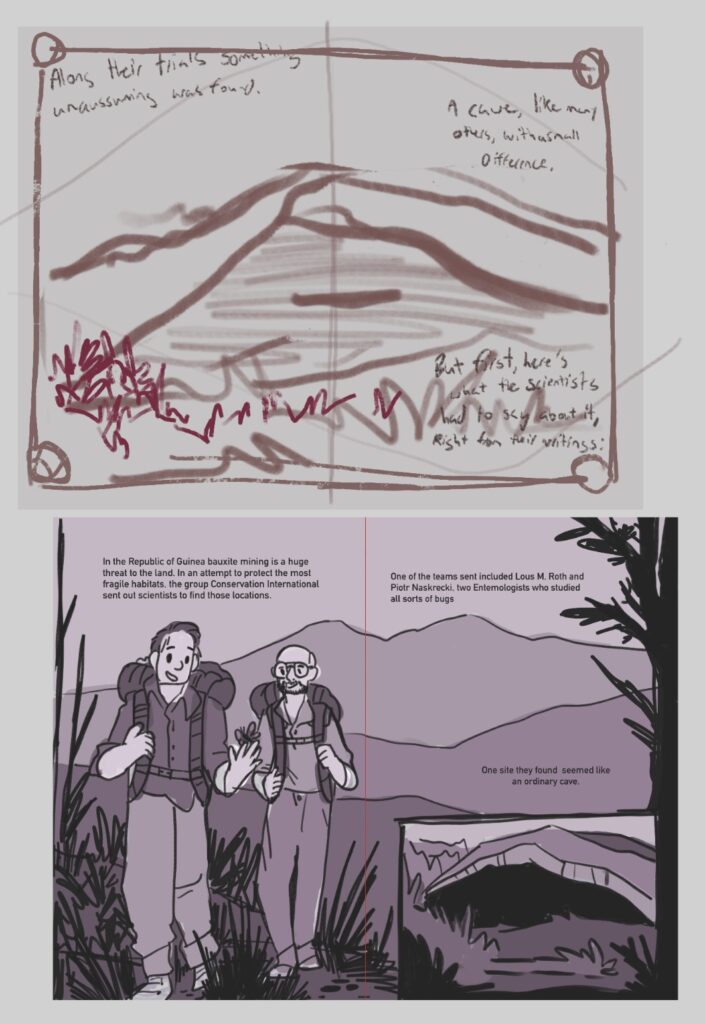
Development art from Bugs in Peril imagining how the discovery of S. conserfariam‘s home cave might have looked like. Maddy Ruth.
AR: Do you have a favorite invertebrate species? A top five?
MR: While Simandoa conserfariam has to be a contender, I’ve definitely got others I love too. Motyxia millipedes are one – I think the fact that they glow in the dark is incredible, and one of these days I will take a trip down to California to find some in the wild. While a more common love, I adore lunar moths – I have only seen a few wild ones when I was younger, but I was overtaken by how beautiful and absolutely huge they are. Orchid bees and sweat bees always dazzle me with all that iridescent beauty. Hawkmoths are just weird with great shapes! I adore their wings. I’ll have to stop there, or I’ll just keep going.
A big thank-you to Maddy for sharing the backstory on Bugs in Peril and their artistic process. If you want a copy of the comic, head over to Microcosm Publishing’s website and get one! If you want to see more of Maddy’s work, check out their website and their Instagram page. And if you want a refresher on the story retold so beautifully in the comic, check out my post here.
Arthroverts.org is all about seeking the lost till all is made new. For invertebrate biodiversity news and more interviews like this one, subscribe to arthroverts.org on Instagram.
Leave a Reply